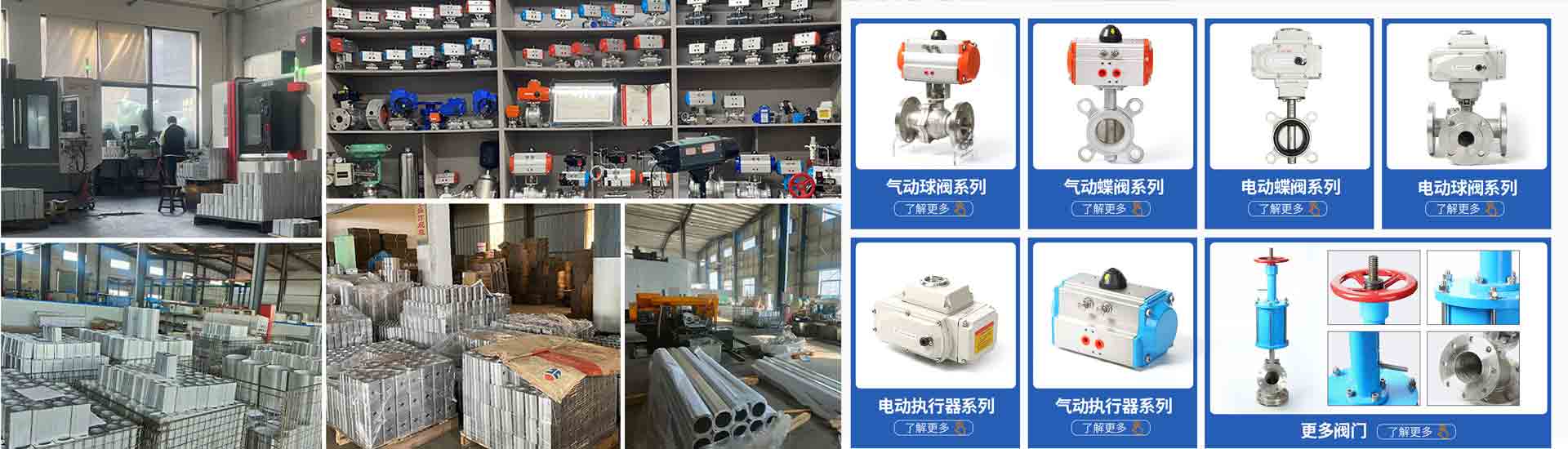
Overview of pneumatic actuators
Pneumatic actuator is a device that uses pneumatic pressure to drive the opening, closing, or regulating of valves. It is commonly referred to as a pneumatic actuator or pneumatic device, commonly known as a "pneumatic head". It is widely used in industries such as power plants, chemicals, and oil refining, and has the characteristics of high torque, small space occupation, and safety and explosion prevention.
Working principle
The working principle of pneumatic actuators is based on the drive of compressed air. When compressed air enters from pipe A, the gas pushes the dual pistons to move towards both ends. The rack on the piston drives the gear to rotate counterclockwise by 90 degrees, and the valve opens. On the contrary, when compressed air enters from pipe B, the piston moves towards the middle, the gear rotates clockwise 90 degrees, and the valve closes. Single acting pneumatic actuators achieve valve closure through spring reset.
basic constitution
Pneumatic actuators are mainly composed of the following parts:
Execution mechanism: including cylinders, pistons, gear shafts, end caps, seals, etc.
Regulating valve: It adjusts fluid flow by generating displacement or angle based on the thrust of the actuator.
Auxiliary devices: such as valve positioners, handwheel mechanisms, solenoid valves, positioners, etc.
performance
The performance of pneumatic actuators is mainly reflected in:
Output force or torque: comply with relevant standards to ensure smooth and unobstructed movement.
Sealing: Under working pressure, the leakage does not exceed the specified value.
Strength: Maintain no leakage or deformation for 3 minutes under 1.5 times the working pressure.
Lifespan: The number of opening and closing operations shall not be less than 50000 times.
appearance
The appearance of pneumatic actuators requires that the castings be free of defects such as scratches and pores, and the surface paint should be smooth, even in color.
advantage
High output power: suitable for high torque output scenarios.
Quick response: fast action speed.
Strong environmental adaptability: suitable for harsh environments such as flammable, explosive, and dusty environments.
Simple maintenance: The structure is simple and easy to maintain.
disadvantage
Low control accuracy: The double acting pneumatic actuator cannot return to the preset position after the gas is cut off.
Continuous air source required: Although single acting pneumatic actuators can rely on spring reset, they still require air source drive.
Classification and selection
Pneumatic actuators are classified into three types based on their energy sources: pneumatic, electric, and hydraulic. Pneumatic actuators are divided into two types: single acting and double acting:
Double acting: The switch action is driven by the air source.
Single action: Start as a gas source drive, close as a spring reset.
When selecting, factors such as valve operating torque, gas source pressure, actuator type, and failure mode should be considered.
Application scenarios
Pneumatic actuators are suitable for simple motion control, such as fast linear cyclic motion, and perform particularly well in explosion-proof, dusty, or humid environments. Electric actuators are more suitable for situations that require precise control, multi-point positioning, or synchronous tracking.
summarize
Pneumatic actuators play an important role in industrial automation due to their high torque, fast response, and good environmental adaptability. Despite its shortcomings in control accuracy, its simple and reliable structure and easy maintenance make it a popular choice in many industrial scenarios**